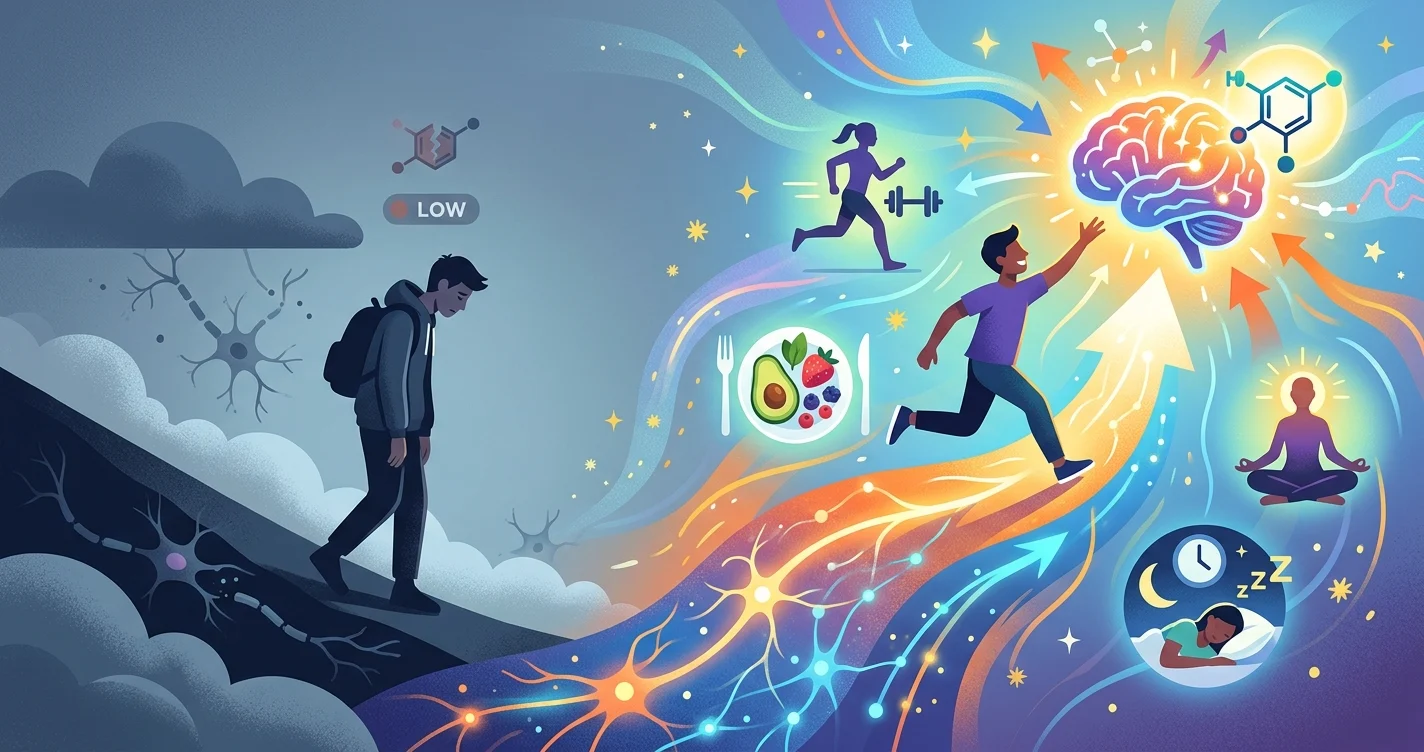

You wake up. You check your phone before your feet hit the floor. By 10 AM you've refreshed 3 apps, started 2 tasks, and finished none of them.
That's not laziness. That's often what low dopamine actually looks like in everyday life.
Dopamine isn't the "pleasure chemical" everyone claims it is. It's the motivation chemical. And when it's running low, nothing feels worth starting.
Here is a practical look at what low dopamine actually means, how to spot the signs in your daily routine, and 5 habits that form an effective, realistic reset.

What Is Low Dopamine, Really?
Dopamine is a neurotransmitter that drives motivation, focus, and the anticipation of reward. It's not really about pleasure itself, but about the pursuit of it.
Most wellness guides skip an important detail: dopamine deficiency isn't a formal medical diagnosis. Unlike clear-cut deficiencies like iron or vitamin B12, low dopamine isn't something confirmed by a simple blood test. Your body regulates dopamine production tightly on its own, so doctors don't treat it as a standalone condition.
When people refer to "low dopamine," they are usually talking about a functional dip rather than a clinical shortage. Your dopamine system is simply under-firing due to daily lifestyle factors rather than a permanently low baseline number.
That distinction matters. It explains why a practical dopamine reset built around daily habits actually works for most people, even without a prescription or formal diagnosis.
What Are the Main Signs of Low Dopamine?
Low dopamine rarely shows up as a single symptom. Instead, it forms a cluster: a heavy lack of motivation, fatigue that sleep does not seem to fix, difficulty focusing, a muted mood, and sometimes physical cues like muscle tightness or low libido.
In practice, it usually feels like this:
- Feeling exhausted even after getting 8 full hours of sleep
- Brain fog where thoughts feel slow, scattered, or hard to hold onto
- Task paralysis, where you know exactly what needs to get done but cannot bring yourself to start
- A flat, muted mood where you do not feel necessarily sad, just emotionally blank
- A constant urge to check your phone because low-effort digital rewards feel much easier to grab
Most people describe this as feeling flat or disconnected rather than sad, as if their inner spark was turned down. That is the crucial difference: depression pulls you down, whereas low dopamine simply switches you off.
Low Dopamine Brain Fog vs Normal Tiredness
This is where confusion usually sets in. Normal tiredness responds well to rest, but dopamine fatigue rarely does.
Even after a full night of sleep, simple tasks that used to be automatic can suddenly require massive mental effort. If a solid weekend off has not cleared the fog, rest alone might not be the issue. Your brain's reward system is likely running on empty.
What Causes Dopamine Levels to Drop?
A few common habits tend to drain your baseline over time:
- Overstimulation: Endless scrolling conditions your brain to expect quick, effortless hits of novelty.
- Poor sleep: Disrupts the dopamine receptors that regulate your drive and focus the following day.
- Chronic stress: Keeps cortisol elevated, which directly suppresses healthy dopamine function.
- Nutrient gaps: Low intake of protein, iron, or B vitamins deprives your body of key building blocks.
- Sedentary routines: Physical movement is one of the most reliable natural dopamine boosters, yet most of us spend hours sitting still.
None of these habits seem catastrophic on their own, but when stacked together for weeks, dopamine fatigue sneaks in quietly.
How to Fix Low Dopamine: 5 Daily Habits
A real dopamine reset is not a quick 24-hour quick fix. It is a series of realistic daily choices that steadily rebuild your mental baseline over time.
1. Start With a Digital Sunset
Try putting your phone away 60 to 90 minutes before bed, and leave it untouched for the first 30 minutes after waking up.
Screens, especially social feeds, deliver dopamine in fast, unpredictable bursts. Your brain adapts quickly to that high pace. Once it adjusts, slower real-world activities like taking a walk, having a real conversation, or finishing a task begin to feel uncomfortably boring.
Protecting your attention around sleep is often the single most powerful shift in a dopamine reset.
2. Move Your Body Before You Touch a Screen
You do not need a intense workout right away. Just 10 to 15 minutes of basic movement, like walking or light stretching, before opening your phone or laptop makes a huge difference.
Exercise is a proven natural dopamine booster, and getting your body moving first sets a healthy baseline for the day before a notification feed decides it for you.

3. Eat for Dopamine Synthesis
Your brain relies on an amino acid called tyrosine to build dopamine. You can find tyrosine in everyday foods like eggs, dairy, fish, and lean meat.
| Nutrient | Role in Dopamine Production | Common Sources |
|---|---|---|
| Tyrosine | Raw material for dopamine synthesis | Eggs, chicken, fish, dairy |
| Iron | Cofactor for dopamine production | Red meat, spinach, lentils |
| B6 & B12 | Support neurotransmitter conversion | Poultry, eggs, fortified grains |

Low dopamine can stem from genetics, chronic stress, poor nutrition, or underlying health factors, which is why diet alone won't solve everything, but it gives your brain the necessary raw materials to rebuild.
4. Rebuild Your Tolerance for Boredom
While it sounds counterintuitive, learning to sit with quiet moments might be the most crucial habit on this list.
Practice sitting quietly without reaching for your phone when you feel a sudden urge for distraction. Start with 5 minutes, then build up to 10. This gradually retrains your nervous system to stop craving constant stimulation, which is the real key behind any effective digital detox.
5. Set 1 Small, Winnable Task Each Morning
Motivation rarely appears out of nowhere before you begin; it builds right after you score a small win.
Select one task you can finish in under 20 minutes and complete it first. Finishing something tangible triggers a natural hit of dopamine, creating the exact momentum needed to tackle harder work.
Motivation isn't something you wait for. It's something you generate by finishing small things first.
How Long Does a Low-Dopamine Reset Take to Work?
Most people notice a noticeable lift in focus and mood within 7 to 14 days of staying consistent. However, deeper recalibration takes a bit longer.
Allowing your brain's receptors to fully adjust generally takes 2 to 4 weeks, while deeply entrenched habits can take up to 90 days to fully transform.
Early gains in daily energy are very real, so those first couple of weeks build the necessary foundation for lasting change.
Why do I still feel exhausted even after sleeping a full eight hours?
Normal sleep can't cure a drained reward system when your brain is running on empty. If a solid weekend of rest hasn't cleared your brain fog, you likely need a functional reset rather than just more hours in bed. Try moving your body for ten minutes before looking at your phone to spark that natural drive.
How quickly will I actually start feeling like myself again?
Expect to feel a noticeable lift in your focus and mood within seven to fourteen days of being consistent. Your brain receptors need about two to four weeks to fully adjust, so stick with the small daily changes even if you don't feel a massive shift overnight. Consistency is what rebuilds that baseline.
Why does it feel so physically painful to just sit without my phone?
Years of endless scrolling have conditioned your brain to expect constant, high-speed rewards. When you remove that stimulation, your nervous system experiences a temporary friction that makes quiet moments feel incredibly boring. Start small by committing to just five minutes of screen-free quiet time and build up your tolerance gradually.
How do I get past that feeling of knowing what to do but not being able to start?
Stop waiting for the motivation to strike you first. Instead, pick one tiny, winnable task that takes less than twenty minutes and finish it right away. Scoring that quick win triggers a small release of dopamine, which naturally generates the momentum you need to tackle the harder stuff.